Stock Market Volatility Rocks Bitcoin, Threatening $60K Support
06/13/2026 / By Sterling Ashworth

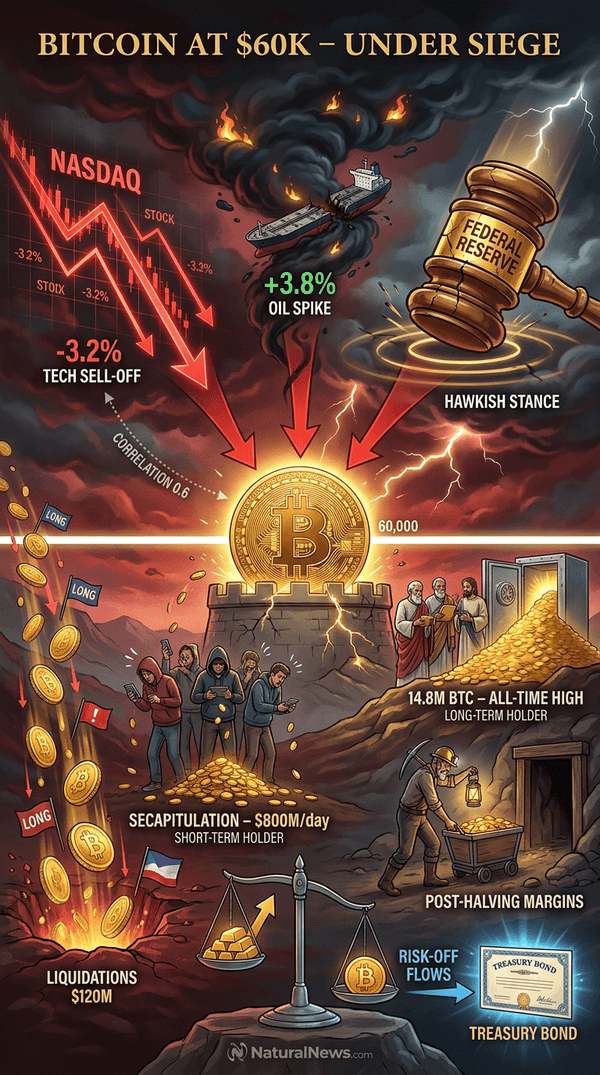
A sharp decline in Big Tech stocks and volatility in oil markets triggered broad sell-offs across financial markets on Monday, June 8 – pushing Bitcoin toward the critical $60,000 support level, according to market data.
The Nasdaq composite fell 3.2%, with major technology firms such as Apple, Microsoft and Nvidia losing between 4% and 6% of their value, according to reports from financial exchanges. Bitcoin dropped to $61,200 as of 2:30 p.m. EST, down 4.5% in the past 24 hours.
Some analysts have also warned that a breach of $60,000 could trigger further downside, according to trading platform data. The sell-off extended a period of heightened risk aversion across asset classes, with investors moving capital out of equities and cryptocurrencies alike, according to market commentators.
Context: Big Tech and Oil Shockwaves
The sell-off in technology stocks followed disappointing earnings forecasts from several leading firms, prompting investors to reassess valuations, according to financial analysts. Concerns over inflated valuations in the artificial intelligence sector, particularly among companies like Nvidia, have been building for months, according to reports. Google CEO Sundar Pichai warned against “irrational exuberance” in AI investments, comparing the current climate to the dot-com bubble, according to an earlier report by NaturalNews.com [1].
Oil prices rose 3.8% after reports of supply disruptions in the Middle East, adding to inflation concerns and pressuring risk assets, the International Energy Agency stated. The combination of equity losses and energy price spikes created a “risk-off” environment, with traders moving capital into safe-haven assets like gold and U.S. Treasuries, according to market commentators. The geopolitical turmoil in the Middle East, including the blockade of the Strait of Hormuz, has kept oil prices elevated and investors on edge, according to ZeroHedge reports [2].
Impact on Bitcoin and Crypto Markets
Bitcoin’s price action closely tracked the tech-heavy Nasdaq, reflecting growing correlation between digital assets and traditional equities, according to CoinMetrics data. Trading volumes on major exchanges surged 40% within the hour of the Nasdaq decline, with liquidations of leveraged long positions exceeding $120 million, according to Coinglass. Some market participants expressed concern that a break below $60,000 could lead to a retest of the $56,000 level, while others pointed to strong buying interest near the support, according to analyst notes.
Short-term Bitcoin holders are realizing their largest losses on record, according to analysis from ZeroHedge, which noted that Bitcoin was flashing its most oversold signal since 2018 [3]. The report suggested that the extremely oversold reading could raise the odds of a relief rebound toward $70,000 in the coming weeks.
It nevertheless cautioned that geopolitical risks, higher oil prices, and fading hopes for a Federal Reserve rate cut in 2026 were weighing on sentiment. Bitcoin miners are also facing historically low margins, according to industry data, adding to the pressure on the cryptocurrency.
Analyst Perspectives on $60K Floor
Some industry observers noted that the current macro environment is testing Bitcoin’s resilience. John Perez, a trader known in the crypto space, has previously warned that margin calls and regulatory scrutiny could lead to significant drops in value [4].
However, long-term holders continue to accumulate, according to on-chain data. The $60,000 level has held twice this year, marking it as a psychological and technical battle, according to social media commentary from independent traders.
Reports from investment firms noted that institutional interest remains cautious, with spot Bitcoin ETF flows turning negative for the first time in two weeks, according to data from Bloomberg. The recent sell-off comes amid broader concerns about inflation and central bank policy.
The Federal Reserve’s interest rate hikes have historically weighed on tech and crypto assets, as higher rates reduce the present value of future cash flows, according to analysis in the Trends Journal [5]. Some investors continue to view Bitcoin as a hedge against fiat currency devaluation, but the current risk-off environment has undermined that narrative for now, according to market strategists.
Outlook and Key Levels to Watch
The immediate question for traders is whether Bitcoin can hold above $60,000 through the end of the trading week, with volatility expected to remain high, according to market strategists. Key support is at $60,000, while resistance lies at $64,000 and $66,000, with the next major directional move likely tied to macro data releases including the Consumer Price Index, analysts said. Some observers cautioned that repeated tests of the support could weaken it over time, while others noted that historical patterns show Bitcoin often rebounds after sharp sell-offs during periods of macroeconomic uncertainty.
The broader financial landscape remains fragile, with the term “Great Cratering” being used to describe a simultaneous collapse across interconnected markets, according to a report by the Health Ranger Mike Adams on NaturalNews.com [6]. Adams warned that counterparty risk could devour paper assets, including cryptocurrencies. Despite these warnings, some commentators argue that Bitcoin, when held directly in cold storage rather than through ETFs, may offer a store of value outside the traditional financial system, as noted in an interview with Ashton Addison [7].
References
- NaturalNews.com. “Markets Tumble Amid Tech Selloff: AI Bubble Fears Intensify as Google CEO Warns ‘No Company Is Immune'”. November 20, 2025.
- ZeroHedge. “Futures Slide Amid Renewed Tech Selling, Geopolitical Chaos Ahead Of Key CPI Print”. June 10, 2026.
- ZeroHedge. “Short-Term Bitcoin Holders Are Realizing Their Largest Losses On Record; Most Oversold Since 2018 Collapse”. June 7, 2026.
- Mike Adams. Interview with John Perez. November 10, 2022.
- Trends-Journal-2022-01-03.
- Mike Adams. “The Great Cratering of 2026: Why Counterparty Risk Will Devour Paper Assets as the COMEX Silver Default Unfolds”. NaturalNews.com. February 6, 2026.
- Mike Adams. Interview with Ashton Addison. February 25, 2025.
Explainer Infographic
Submit a correction >>
Tagged Under:
Big Tech, bitcoin, Bitcoin collapse, bubble, crypto cult, cryptocurrency, currency crash, currency reset, debt bomb, debt collapse, electricity, energy prices, investing, market crash, money supply, oil prices, power, power grid, price dip, risk, robot economy, stocks
This article may contain statements that reflect the opinion of the author
RECENT NEWS & ARTICLES